Slides & Script
Build your webinar slide by slide with script narration
1
Moving To Cleveland
Welcome to this essential webinar for anyone considering a move to Cleveland. Today, I'm sharing insights gathered directly from our agents in the trenches—the professionals who work with relocating families every single day. These aren't marketing materials or city tourism pitches. This is the unfiltered truth about what it really takes to make a successful Cleveland move. We'll cover three critical insights that will fundamentally change how you approach your decision, plus a concrete gameplan including the exact questions you need to ask any agent to know if they're right for you. Let's dive in.
2
What We Know
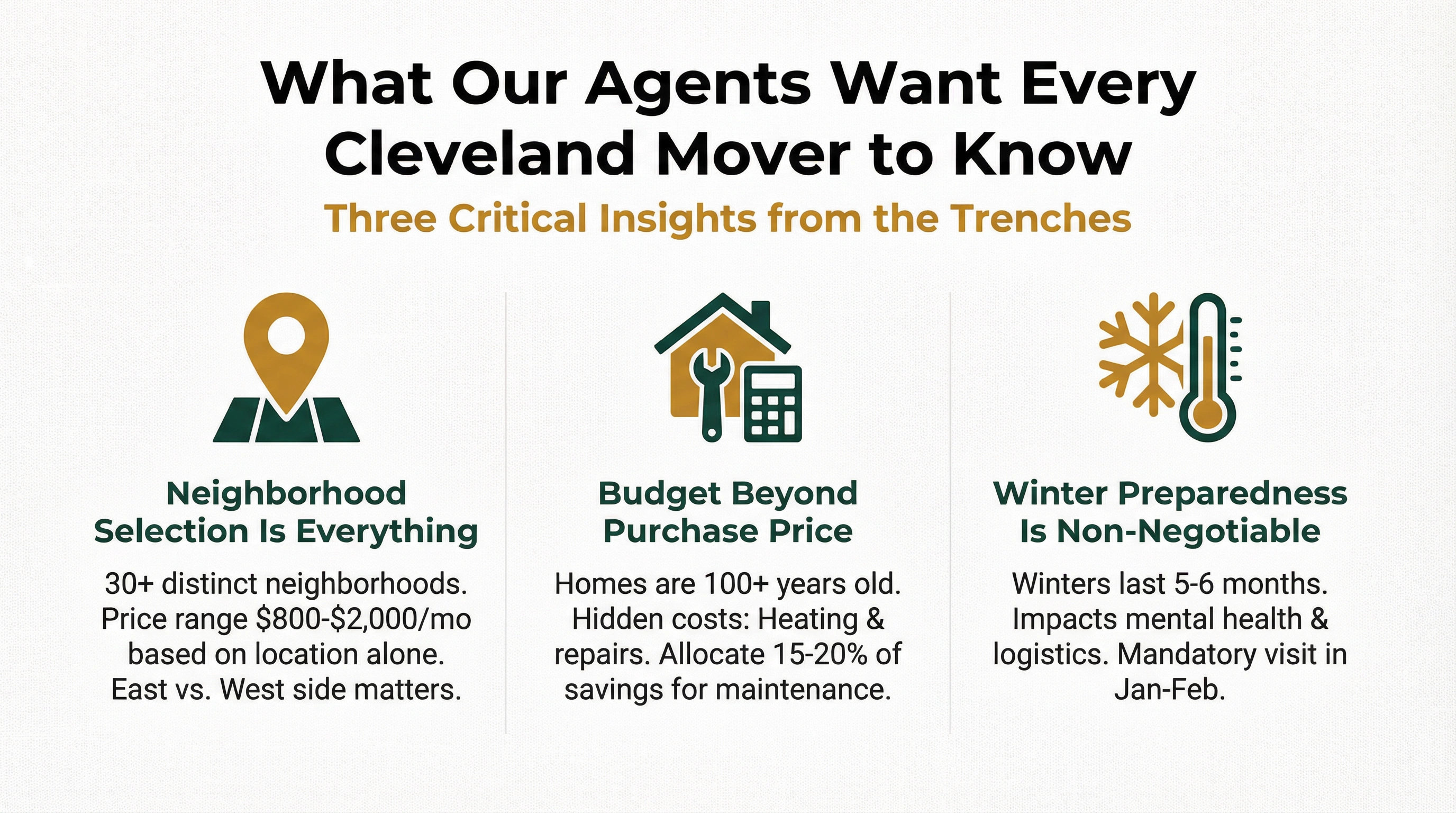
Our agents have identified three critical insights that separate successful Cleveland moves from regretful ones. First, neighborhood selection is everything. Cleveland isn't one homogeneous city—it's over 30 distinct neighborhoods with radically different realities. You can find similar-sized homes ranging from $800 to $2,000 per month based solely on location. The East side and West side feel like different cities. Your neighborhood choice will determine your lifestyle, safety, cultural access, and long-term value more than in almost any other American city. Second, budget beyond the purchase price. Yes, Cleveland is affordable, but most homes are over 100 years old. Our agents see buyers surprised by winter heating bills that double or triple, aging infrastructure that needs replacement, and weatherproofing costs. The smart formula: take 15 to 20 percent of what you're saving on housing and allocate it for annual maintenance. The affordability is real, but it comes with a trade-off you must plan for. Third, winter preparedness is non-negotiable. Cleveland winters last five to six months with lake-effect snow and persistent gray skies. This affects your mental health, social life, home costs, and daily logistics. Our agents insist: visit in January or February before you commit. Experience the reality. Successful Cleveland movers prepare for winter mentally, financially, and practically—it's not optional.
3
Where To Live
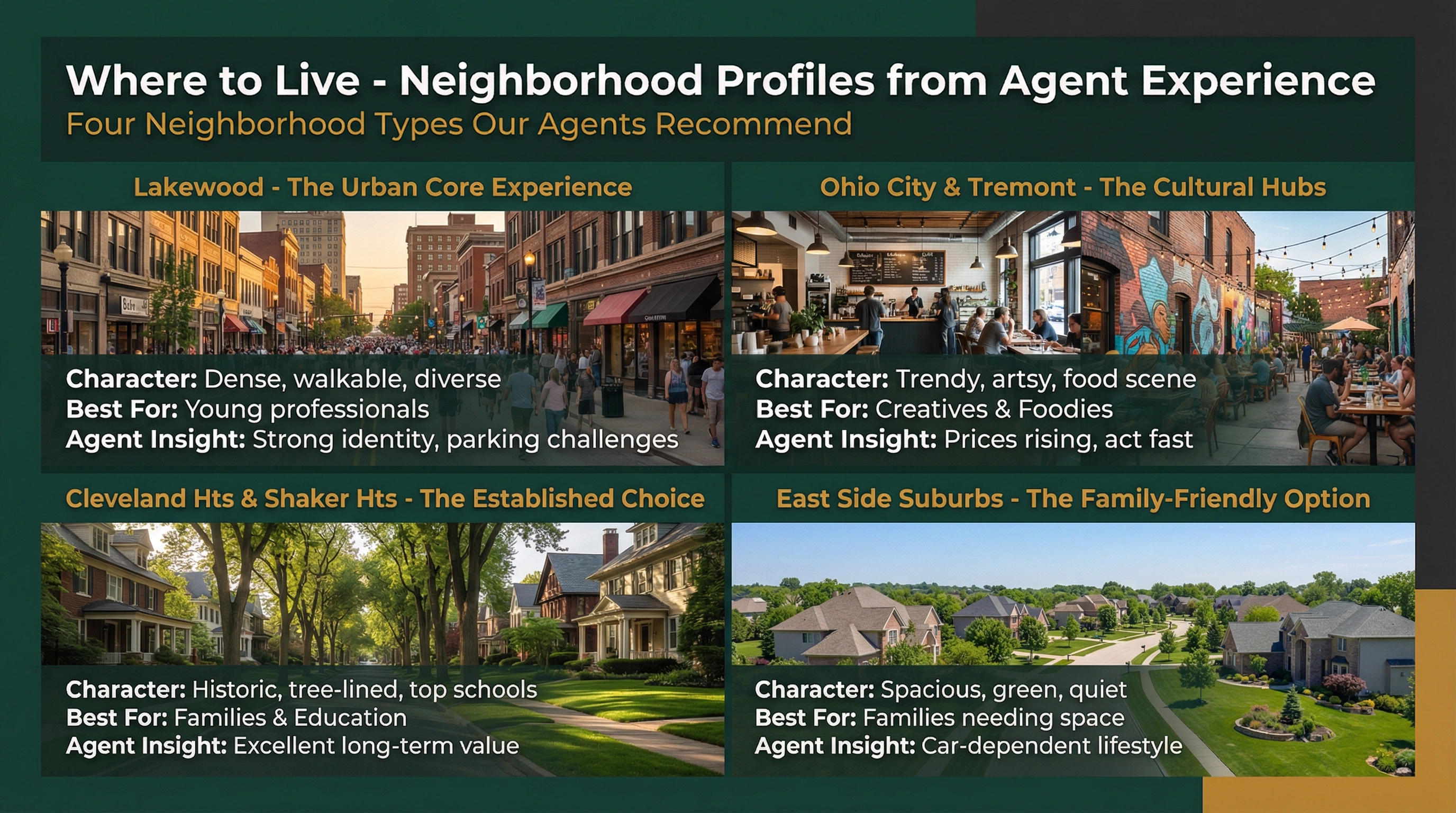
Based on our agents' extensive experience, here are the four neighborhood types they consistently recommend. First, Lakewood—this is the urban core experience. Dense, walkable, diverse, with an urban feel close to downtown. Best for young professionals who prioritize walkability. Our agents note the strong community identity here, though parking can be challenging. Second, Ohio City and Tremont—the cultural hubs. These are trendy, artsy neighborhoods with excellent food scenes. Perfect for foodies, creative professionals, and urban lifestyle seekers. Agent insight: prices are rising rapidly due to gentrification, so you need to act quickly when inventory appears. Third, Cleveland Heights and Shaker Heights—the established choice. These are tree-lined, historic neighborhoods with strong schools and community orientation. Best for families prioritizing education and neighborhood stability. Our agents say these are more expensive upfront but offer excellent long-term value. Fourth, the East Side suburbs—the family-friendly option. Spacious, green, excellent schools, suburban feel. Ideal for families with kids who prefer quiet and space. Agent insight: these areas are less walkable and car-dependent, and you'll be further from urban amenities. Choose based on your life stage and what matters most to your family.
4
Slide 4
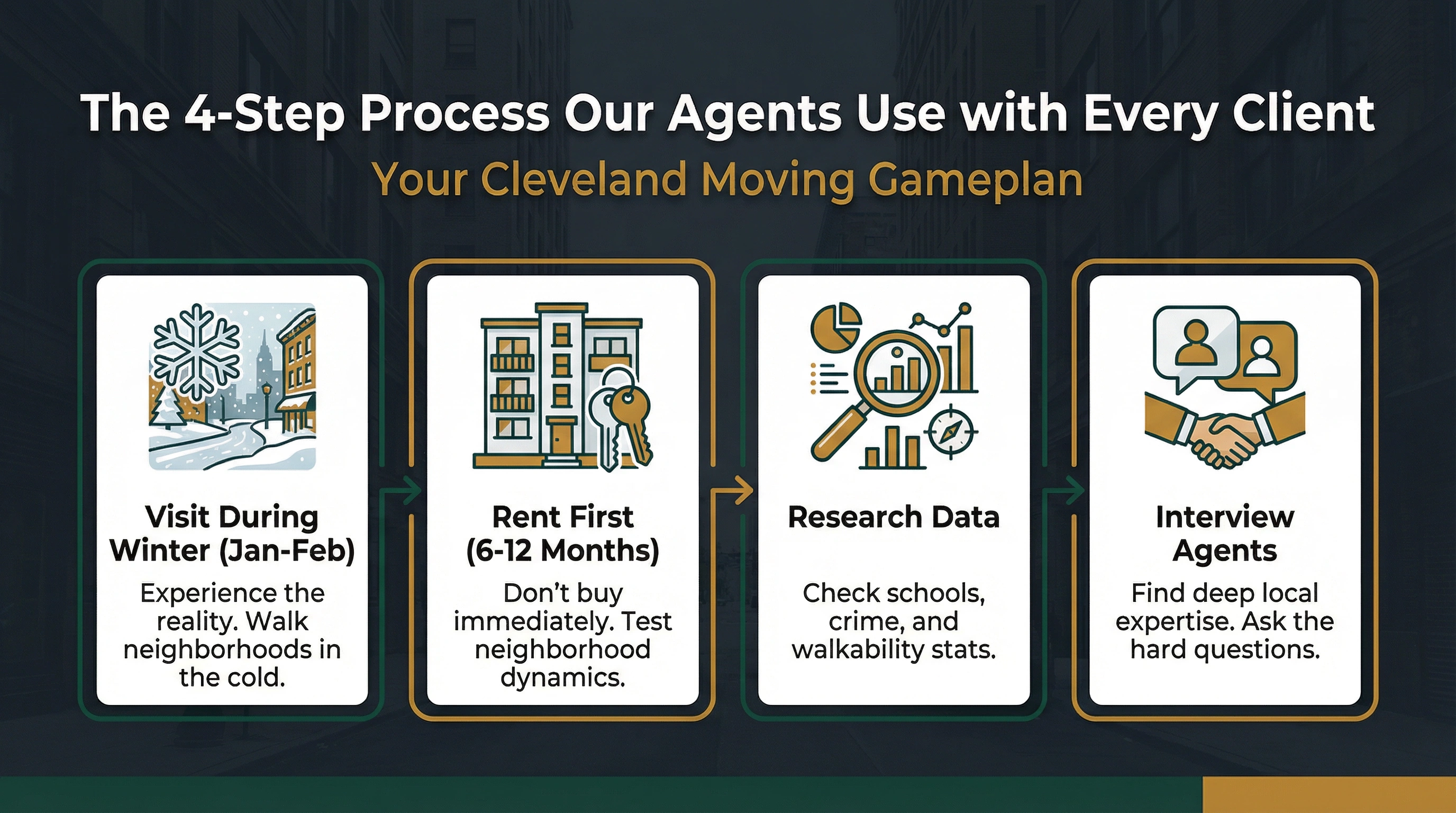
Here's the four-step gameplan our agents use with every serious Cleveland mover. Step One: Visit during winter, specifically January or February. You must experience Cleveland at its most challenging. Walk your target neighborhoods in the cold. Drive in snow conditions. Spend at least three to four days, not just a weekend. This is your reality check. Step Two: Rent first for six to twelve months. Our agents strongly advise against buying immediately. You need to test the neighborhood, experience a full winter, and understand seasonal changes and community dynamics. Use this rental period to explore alternatives you didn't initially consider. Step Three: Research neighborhood-specific data. School quality varies dramatically by district if you have kids. Look at crime statistics by specific neighborhood, not misleading city-wide averages. Check walkability scores and study recent development patterns to understand trajectory. Step Four: Interview multiple expert agents. You're not looking for the highest sales volume—you're looking for deep local knowledge. Our agents say you should interview at least three professionals and evaluate their honesty about challenges, not just their enthusiasm about opportunities. This brings us to the most important tool in your arsenal.
5
Slide 5
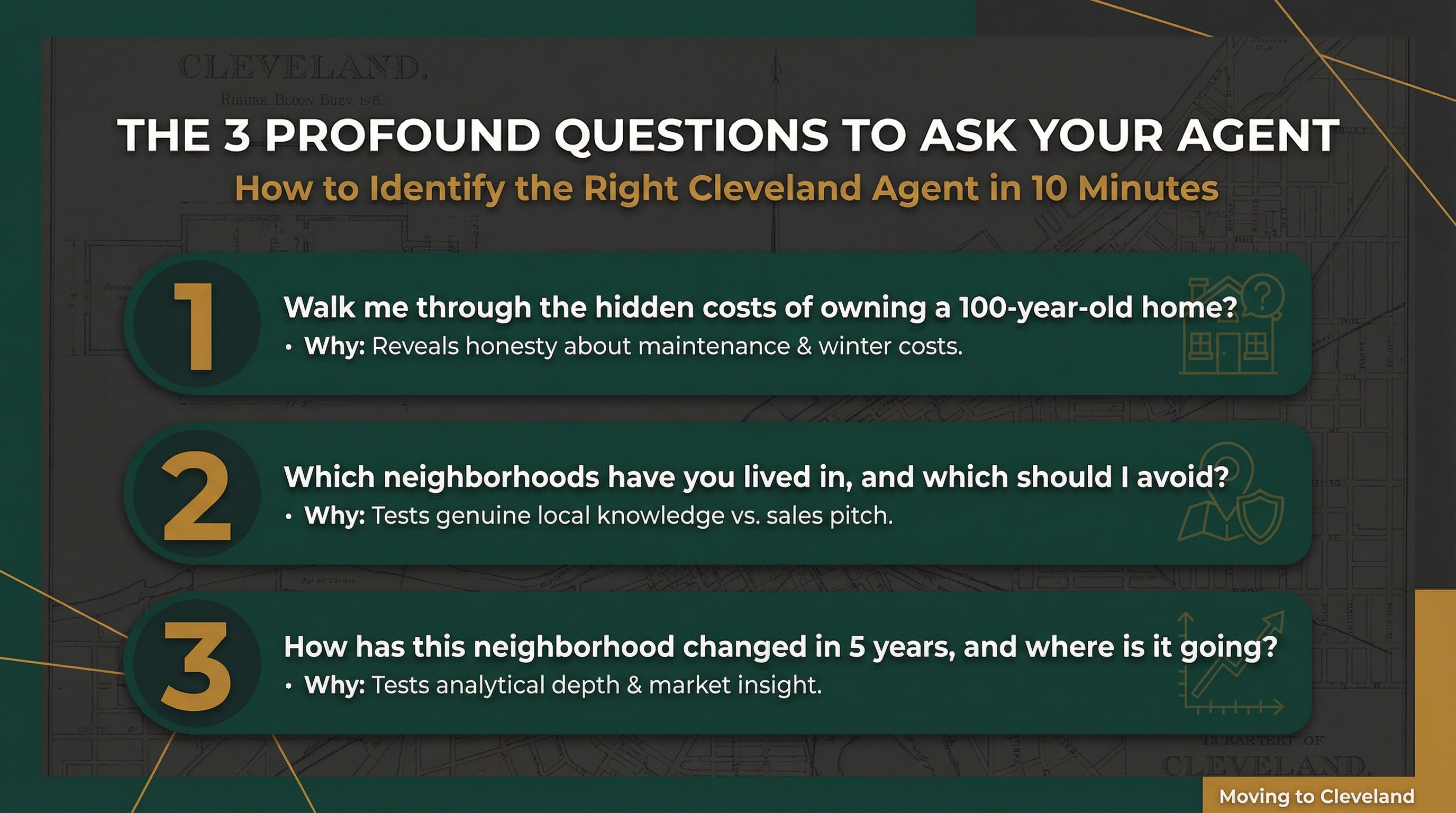
Here are the three profound questions our top agents say will immediately reveal whether you're working with the right professional. Question One: "Walk me through the hidden costs of owning a 100-year-old home in Cleveland—what should I budget annually beyond my mortgage for maintenance, utilities, and winter preparedness?" Why this reveals everything: it tests if the agent understands total cost of ownership versus just selling you on an attractive purchase price. A great agent will give you specific numbers—they'll discuss furnace lifespans, roof replacement timelines, window efficiency, and realistic winter heating costs. If they gloss over this or give vague answers, walk away. Question Two: "Which neighborhoods have you personally lived in, and which would you choose for your own family today—and more importantly, which neighborhoods should I avoid and why?" Why this reveals everything: it tests genuine local knowledge versus a sales pitch. An honest agent will tell you where NOT to buy and explain the subtle but important differences between neighborhoods that seem similar on paper. If they won't name neighborhoods to avoid or claim everywhere is great, they're not being honest with you. Question Three: "How has this specific neighborhood I'm interested in changed in the past 5 years, and where do you see it in 5 years—what are the leading indicators you're watching?" Why this reveals everything: it tests analytical depth. A great agent won't just say "it's up and coming"—they'll discuss specific developments, demographic shifts, investment patterns, and data points they're tracking. This is how you separate agents who know Cleveland from agents who just sell houses.
6
Next Steps
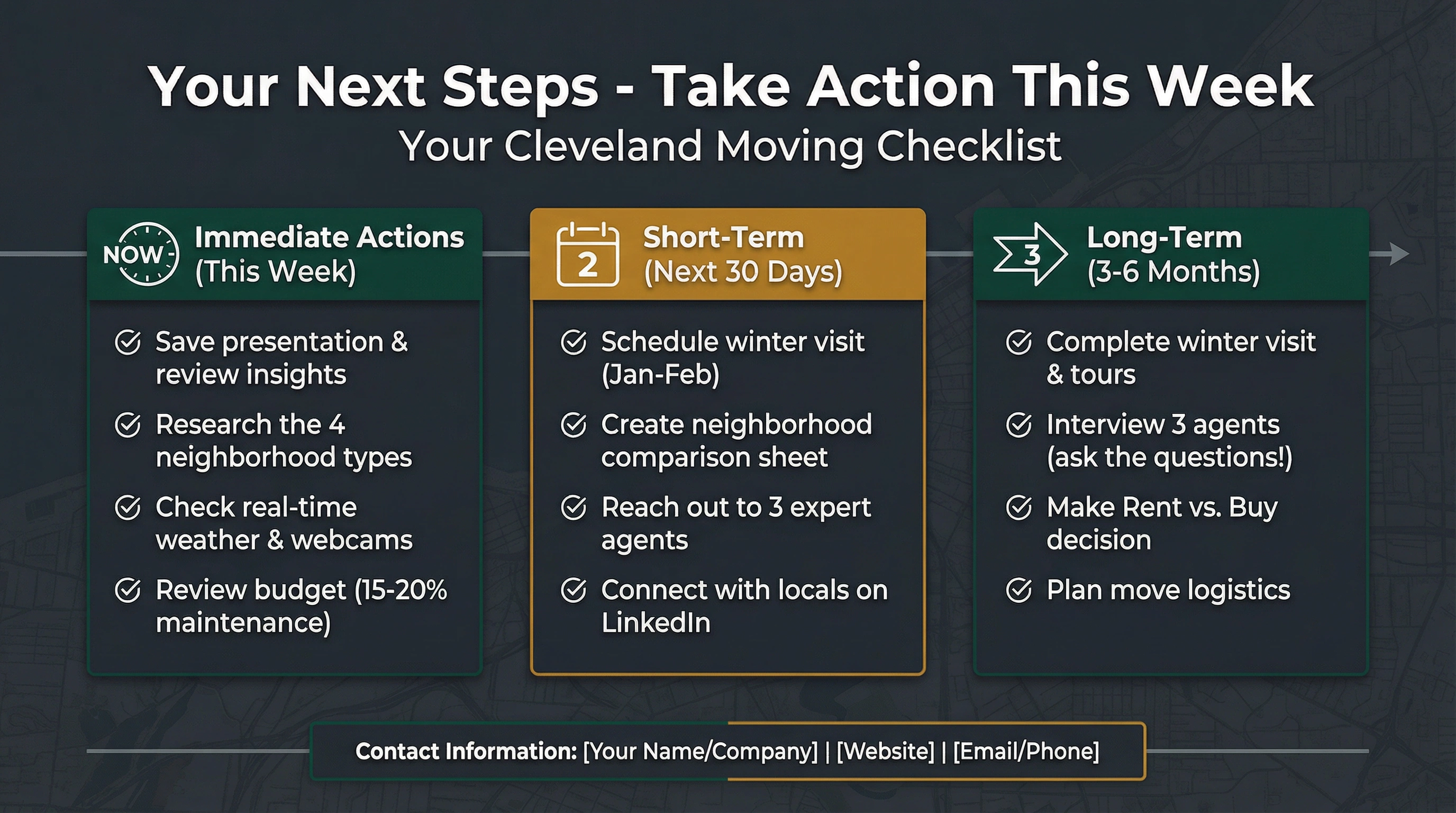
Let's make this actionable. Here's your Cleveland moving checklist. Immediate actions for this week: Save this presentation and review those three critical insights. Research the four neighborhood types we discussed to narrow your focus. Check Cleveland weather forecasts and webcams to see what conditions are actually like right now. And review your budget using our 15 to 20 percent maintenance framework—this is crucial. Short-term actions for the next 30 days: Schedule a winter visit to Cleveland. If you're watching this outside of winter, mark your calendar for January or February. Create a comparison spreadsheet for three to five target neighborhoods across the criteria that matter to you. Identify and reach out to three expert Cleveland agents—remember, you're evaluating them, not the other way around. And connect with Cleveland professionals in your industry via LinkedIn to understand the job market from insiders. Long-term actions for the next three to six months: Complete your Cleveland winter visit with actual neighborhood tours. Interview at least three agents using those profound questions we discussed. Make your rent-versus-buy decision based on your timeline and risk tolerance. And plan your move logistics with winter weather in mind—moving in winter is challenging but cheaper; moving in summer is easier but more expensive. Cleveland can be an excellent move for the right person with the right preparation. Use this gameplan, ask the tough questions, and make your decision with eyes wide open. If you'd like to work with our team of Cleveland experts, here's how to reach us. Thank you for joining this webinar, and best of luck with your Cleveland journey.